
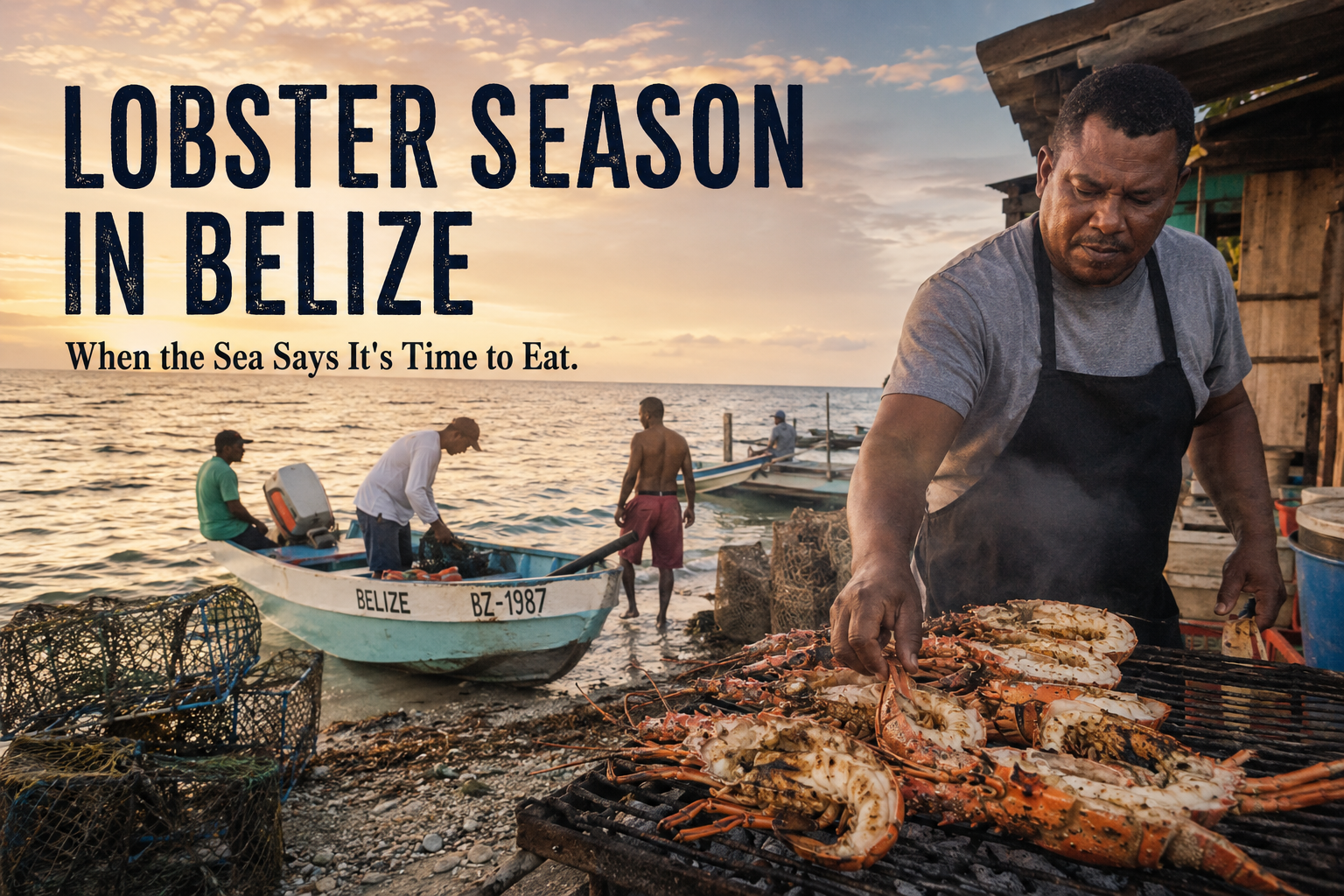
There is a peculiar thing about lobster in Belize.
For four months of the year, the correct answer is:
No.
No matter how badly you want it.
No matter how beautiful the restaurant.
No matter how much garlic butter is involved.
Then July 1 arrives.
Boats go out.
Kitchens get busy.
Menus change.
And in several coastal communities, Belize responds to the opening of lobster season in the most Belizean way imaginable.
We throw a party.
Actually, several parties.
Welcome to lobster season in Belize.
But before we get to the festivals, grills and plates, there is something visitors should understand.
Lobster season isn’t simply about when lobster tastes best.
It is about knowing when to leave the lobster alone.
When Is Lobster Season in Belize?
Belize’s Caribbean spiny lobster season opens on July 1.
The annual closed season runs from March 1 through June 30.
That closure exists to protect the fishery during an important part of its reproductive cycle.
The practical rule for travelers is beautifully simple:
If you want fresh local lobster in Belize, July through February is your window.
If somebody is offering you suspiciously “fresh Belizean lobster” during the closed season, enthusiasm is not the appropriate response.
Questions are.
Meet the Caribbean Spiny Lobster
The lobster on Belizean plates is not the giant-clawed creature many North American visitors picture when they hear the word.
Belize’s commercially important species is the Caribbean spiny lobster, Panulirus argus.
No enormous claws.
Plenty of antennae.
A hard, spiny shell.
And a tail responsible for a frankly unreasonable amount of garlic butter.
The species occurs throughout the wider Caribbean, but in Belize it is intertwined with fishing communities, cooperatives, restaurants and tourism.
So when lobster season opens, something much larger than a menu changes.
An economy moves with it.
Why Does Belize Close Lobster Season?
Because you cannot continually remove something from the sea and expect the sea to behave as though nothing happened.
This is where seasonal eating becomes conservation.
Belize’s Fisheries Department prohibits fishing, buying or selling soft-shell moulting lobster and egg-bearing females. It is also illegal to remove the eggs—or the fibres to which they were attached—from a female lobster.
Those aren’t fussy technicalities.
They are attempts to allow lobsters to reproduce and the population to replenish.
The Fisheries Department puts the principle plainly: regulations protect fish stocks so they can be sustainably used and replenished.
That means the closed season is not the unfortunate period when Belize deprives tourists of seafood.
It is part of the reason there may still be seafood for future tourists—and Belizeans—to eat.
Lobster Season Begins Long Before the Plate
It is easy to encounter lobster only at the final stage.
Beautifully grilled.
Butter running down the side.
Maybe some rice.
Maybe vegetables nobody touches because there is lobster sitting right there.
But somebody went to sea for that meal.
Travel Belize describes fisherfolk preparing traps and gear for the July 1 opening of spiny lobster season.
For coastal communities, fishing knowledge includes things a restaurant guest rarely has to consider:
Weather.
Reef.
Current.
Season.
Size.
Where lobster might be.
What can legally be taken.
What must remain.
This is food before it becomes cuisine.
And that distinction matters.
Then Belize Turns the Opening Into Lobsterfest
Belize does not quietly acknowledge lobster season.
Three destinations have become particularly associated with annual Lobsterfest celebrations:
San Pedro, Placencia and Caye Caulker.
In 2026, the official Belize tourism calendar promoted San Pedro’s festival from July 1–11, Placencia’s from July 3–5, and Caye Caulker’s from July 17–19.
By late August, those parties have passed.
The lobster season has not.
That’s useful for travelers to understand.
You do not need to visit during Lobsterfest to eat lobster in Belize.
Lobsterfest celebrates the opening.
The season continues afterward.
Caye Caulker Started Something
The modern Lobsterfest story in Belize traces back to Caye Caulker in 1994.
According to Travel Belize, it began with barbecue fundraisers organized by the Islanders Veteran Football Club and eventually grew into the larger celebration that inspired festivities elsewhere.
Think about that for a moment.
Something that now appears on international travel calendars began as a community fundraiser.
That is exactly the kind of detail tourism marketing often skips.
Festivals can become products.
Before they become products, they are usually somebody’s idea.
Somebody volunteered.
Somebody cooked.
Somebody needed to raise money.
Somebody said:
“We could sell lobster.”
And apparently Belize said:
“Continue.”
San Pedro Makes Lobster a Crawl
San Pedro takes a particularly ambitious approach.
The annual festival includes a Lobster Crawl, during which participating restaurants create featured lobster dishes and festival-goers collect stamps in a passport.
The celebration culminates in a large block party with food, music and entertainment.
This tells us something about how food tourism has evolved in Belize.
Lobster is no longer simply something visitors order.
It becomes an itinerary.
A reason to move from restaurant to restaurant.
A reason to stay another night.
A reason to visit the island at a particular time of year.
Food becomes destination marketing.
Placencia Brings It to the Beach
Farther south, Placencia’s version grows out of another community with deep fishing connections.
The 2026 Placencia Lobsterfest was organized by the Placencia Village Council and the local chapter of the Belize Tourism Industry Association, with food, music, games and beach celebrations.
The festival also generates opportunities beyond restaurants.
Artisans sell.
Vendors sell.
Musicians perform.
Hotels fill rooms.
Tourism businesses receive visitors.
One lobster moves through an entire local economy without ever leaving the plate.
How Do Belizeans Eat Lobster?
Now we can discuss the important matter.
Food.
There is no single correct Belizean lobster preparation.
Grill it.
Butter it.
Curry it.
Put it in ceviche.
Turn it into chowder.
Put it in tacos.
Add it to pasta.
Put it on a skewer.
Someone somewhere will probably put it on a pizza.
Recent Belize Lobsterfest menus and coverage show exactly that kind of culinary range, from grilled lobster and tacos to chowders, ceviche and creative restaurant dishes.
Personally, this is where food festivals become interesting.
Tradition meets somebody in a kitchen who says:
“Hear me out.”
Sometimes this produces brilliance.
Sometimes the lobster probably wishes the closed season had continued.
Experimentation has risks.
Should You Eat Lobster in Belize During Closed Season?
If someone claims it is fresh local lobster, no.
The closed season exists for a reason.
And responsible tourism doesn’t mean obeying environmental rules only when they are convenient.
A visitor may think:
I’m only buying one plate.
But markets respond to demand.
If tourists reward businesses for supplying protected seafood out of season, they create an incentive for somebody to provide it.
So one of the easiest sustainable-travel decisions you can make in Belize requires absolutely no hardship:
Eat something else.
This country is not suffering from a shortage of food.
We will find something for you.
Ask Better Questions About Your Seafood
Travel has trained us to ask:
“What’s good here?”
Try adding:
“What’s in season?”
That question can change the way you eat.
It connects your plate to the environment around you.
Belize has other regulated fisheries too, including queen conch.
Seasonal restrictions remind us that seafood does not originate in a restaurant freezer.
It comes from ecosystems with limits.
Knowing the season is part of knowing the food.
Lobster Is Also a Story About Work
There is another person easily lost between the ocean and Instagram.
The fisher.
The Fisheries Department’s regulatory system covers commercial fishing licences, vessels, catch logs and enforcement alongside species protections.
That tells us lobster isn’t merely a tourism delicacy.
It is a managed livelihood.
For generations, fishing communities along Belize’s coast and cayes have built knowledge around the sea.
What visitors experience as a delicious dinner may represent hours of labor and years of accumulated local knowledge.
That deserves recognition.
And preferably fair payment.
The Best Lobster Meal May Not Be the Fancy One
There is absolutely nothing wrong with a beautiful restaurant.
Belize has some excellent ones.
But food memories are unpredictable.
Sometimes the plate you remember comes from somewhere with linen napkins.
Sometimes it comes from a grill outside.
Sometimes you’re eating beside the sea.
Sometimes someone hands you food in a container while you’re standing up.
The setting matters less than whether somebody knew what they were doing.
So during lobster season, explore.
Try the restaurant.
Try the festival vendor.
Ask where the lobster came from.
Ask how they prepared it.
Ask whether this is how their family cooks it.
The answer may be more memorable than the menu description.
July 1 Is Really About July 1 Next Year
This is the part of lobster season worth remembering.
The opening day feels like abundance.
Boats.
Food.
Festivals.
Crowds.
Music.
But the closed season tells the more important story.
Belize is acknowledging that abundance requires restraint.
There must be a time to catch.
And a time not to.
A time to sell.
And a time to leave something in the sea.
That rhythm is older than tourism.
And if we want future generations to celebrate lobster season, it needs to survive tourism too.
So yes.
Come to Belize.
Eat the lobster.
Get the garlic butter everywhere.
Attend Lobsterfest.
Try something ridiculous involving lobster that a chef dreamed up at 2 a.m.
Enjoy it.
But remember what July 1 actually means.
The celebration exists because for four months beforehand, the answer was:
Not yet.
And sometimes knowing when not to take something is how you make sure there will still be something worth celebrating when the season comes around again.

Author: Tiffany Simpson
Tiffany Simpson is a Belizean writer and editor helping people turn lived experiences, personal histories and ideas into stories worth keeping. Her work explores the intersections of identity, culture and storytelling, with a particular interest in Belizean, Caribbean and African diasporic voices. Through Stories of Belize, she is building a cultural storytelling hub that documents the people, traditions, food and everyday experiences that shape Belize; at home and across the diaspora.