
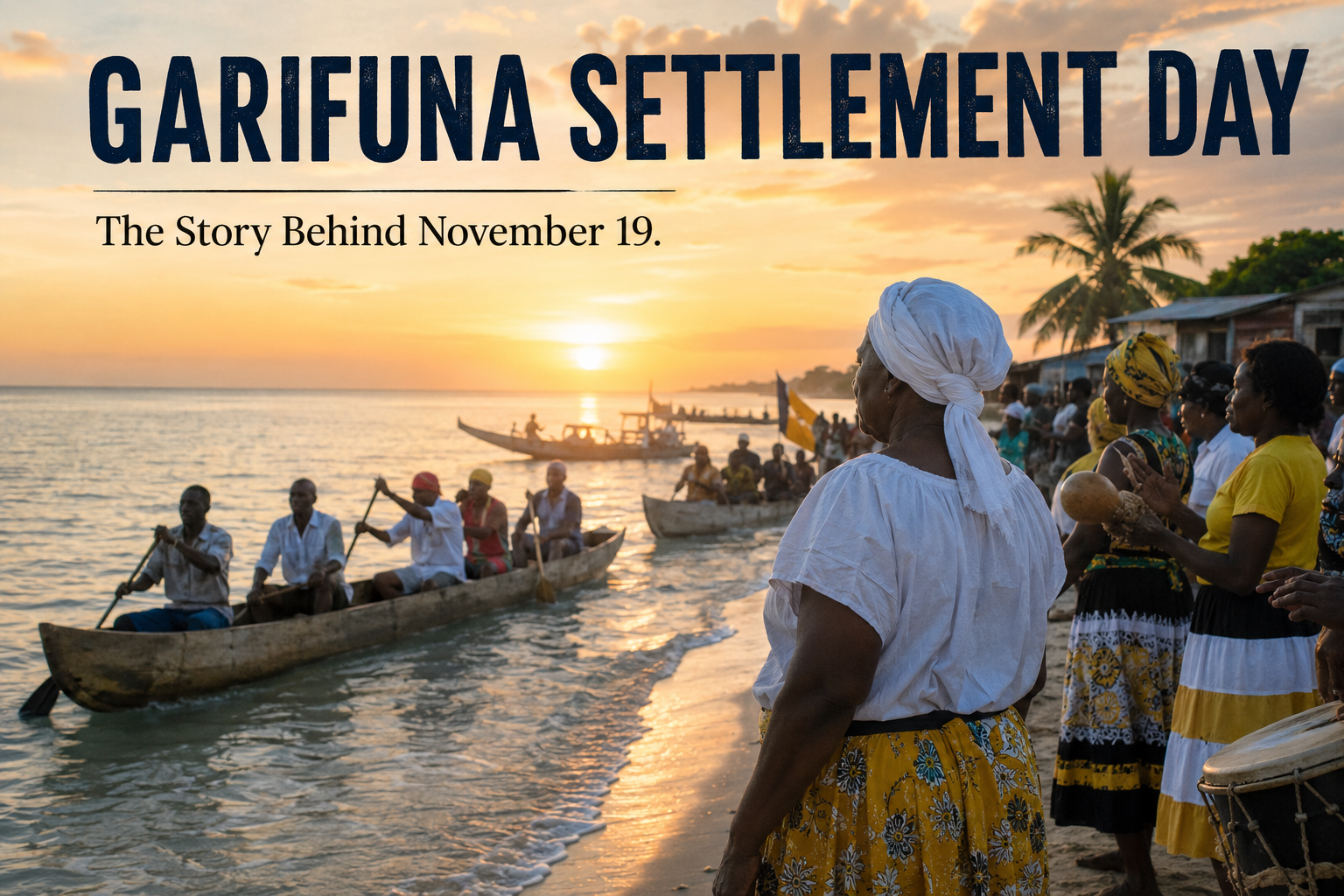
Before the parade, there are boats.
Before the street fills with people, before the food starts disappearing from plates, before drums take over the morning, something happens along the shoreline.
Canoes approach.
People aboard them sing.
Drums answer.
Those waiting on land watch as Garifuna descendants reenact an arrival their ancestors made generations ago.
The ceremony is called Yurumein.
And every November 19, it asks Belize to remember something larger than a holiday.
It asks us to remember a journey.
November 19 Is Garifuna Settlement Day
Garifuna Settlement Day is celebrated annually on November 19 in Belize.
Today, celebrations take place in communities including Dangriga, Hopkins, Punta Gorda, Barranco, Georgetown and elsewhere around the country. Belize’s official tourism authority describes the morning Yurumein reenactment as descendants arriving by canoe while singing and drumming, followed by processions, music, dancing and food.
For a visitor, it can be spectacular.
For the Garifuna community, however, spectacle is not the point.
November 19 is about memory.
And to understand what is being remembered, we have to leave Belize for a moment.
The Story Doesn’t Begin in Belize
Garifuna history crosses several countries and centuries.
UNESCO describes the Garifuna as a people whose culture incorporates Indigenous Caribbean and African elements. After being forced from the Caribbean island of Saint Vincent in the eighteenth century, Garifuna communities eventually became established along the Atlantic coast of Central America, particularly in present-day Belize, Guatemala, Honduras and Nicaragua.
That means Garifuna history cannot be neatly placed inside the borders of modern Belize.
It is Caribbean history.
African diaspora history.
Indigenous history.
Central American history.
Migration history.
And survival history.
All at once.
Perhaps that is why the sight of boats approaching the shore matters so much.
The boats aren’t simply recreating transportation.
They are recreating arrival after displacement.
Yurumein Changes the Meaning of the Celebration
Imagine watching the reenactment without knowing any of that history.
You see colorful clothing.
You hear drums.
People are singing.
You take photographs.
Beautiful.
Now watch it again knowing that the culture being celebrated survived forced removal, migration, discrimination and centuries of pressure.
The same scene becomes something else.
UNESCO’s reporting on Garifuna heritage in Belize describes Yurumein as a public reenactment of Garifuna arrival and notes that Settlement Day activities reinforce cultural identity, pride and social cohesion across generations.
That is the difference between attending an event and understanding one.
Stories of Belize wants you to do both.
The Drums Are Not Background Music
If there is one thing visitors associate immediately with Garifuna culture, it is probably drumming.
And understandably so.
You don’t simply hear a Garifuna drum.
You feel it.
But reducing Garifuna culture to drums would be like describing Belizean culture entirely through rice and beans.
We would appreciate the compliment.
We would also have questions.
Garifuna musical traditions contain history.
UNESCO notes that Garifuna melodies combine African and Indigenous elements and that song texts preserve traditional knowledge about fishing, cassava cultivation, canoe building and other aspects of life. Some songs contain satire; storytelling traditions are also intertwined with language and community gatherings.
Music, then, is not simply entertainment added to culture.
Music can be an archive.
A Language Can Carry an Entire World
The Garifuna language belongs to the Arawakan language family.
UNESCO describes it as having survived centuries of discrimination and linguistic domination. It contains a rich oral tradition, including stories known as úraga, historically told at wakes and larger gatherings.
That matters because languages carry things translations cannot always preserve perfectly.
Humor.
Rhythm.
Relationships.
Ways of naming the world.
Ways of understanding it.
And this part of the story is not entirely celebratory.
UNESCO continues to identify threats to transmission of the Garifuna language, including economic migration, discrimination and reduced intergenerational use. Safeguarding efforts have consequently focused heavily on revitalization, teaching and practice.
So when children speak Garifuna during Settlement Day activities, that isn’t merely adorable festival content.
It is continuity.
Then There Is the Food
Eventually, somebody is going to feed you.
This is Belize.
We have standards.
Garifuna cuisine is one of the easiest doors through which visitors can begin exploring the culture.
Hudut may be the dish outsiders hear about most often: fish served with a coconut-based broth and mashed plantain.
But the table is much larger.
Cassava bread.
Tapou.
Fish.
Cassava pastries.
Sahou.
And dishes built around ingredients including coconut, plantain and cassava.
Travel Belize specifically highlights hudut, tapou, cassava bread and fried fish among foods associated with Settlement Day, while its Hopkins destination guide points travelers toward Garifuna cooking experiences using cassava, coconuts, plantains and fish.
But once again, the food is carrying information.
Cassava isn’t simply an ingredient.
Fishing isn’t simply a menu category.
Foodways tell us what communities grew, caught, preserved, transported and taught to the next generation.
A recipe can be a historical document you get to eat.
Possibly the best kind.
Dangriga Is Important — But Garifuna Belize Is Bigger Than Dangriga
For many people, Garifuna Settlement Day and Dangriga are almost inseparable.
And with good reason.
Dangriga is one of Belize’s major Garifuna communities and one of the most significant centers of the November celebrations.
But Garifuna life in Belize extends beyond one town.
Communities are also strongly represented in Hopkins, Punta Gorda, Seine Bight, Georgetown and Barranco, among others.
That means travelers interested in Garifuna culture don’t need to think of November 19 as the only day culture becomes available for viewing.
Culture isn’t seasonal entertainment.
People are living it in February too.
Visit Hopkins and Listen Differently
Hopkins is often described as a cultural center of Belize’s Garifuna community.
Visitors can encounter cooking, drumming, dance and local food there throughout the year. Travel Belize specifically highlights Paranda and Punta music, Garifuna cooking and Jankunu dance among cultural experiences in the village.
This makes Hopkins an interesting example of what cultural tourism can become when done well.
A visitor isn’t merely looking at a performance.
They can learn.
Ask questions.
Try the drum.
Cook.
Listen.
Understand where something comes from.
That exchange is much richer than arriving, taking a photograph of somebody in cultural clothing and leaving.
UNESCO Recognition Is Important — But Survival Happened Before UNESCO
In 2001, UNESCO proclaimed Garifuna language, dance and music a Masterpiece of the Oral and Intangible Heritage of Humanity. The traditions were subsequently inscribed in 2008 on UNESCO’s Representative List of the Intangible Cultural Heritage of Humanity.
That recognition matters.
It brings international attention to the cultural significance of Garifuna traditions and the need to safeguard them.
But UNESCO didn’t make Garifuna culture valuable.
The people who carried it did.
The grandmother who spoke the language.
The person who taught a child a rhythm.
The family that made cassava bread.
The storyteller who remembered an úraga.
The musician who learned the old songs.
The community that kept celebrating November 19.
Institutions can recognize heritage.
Communities keep it alive.
How Should Visitors Experience Garifuna Settlement Day?
Come.
Absolutely come.
Watch Yurumein.
Listen to the drums.
Follow the procession.
Eat.
Dance if you’re invited.
Ask questions.
Buy food and crafts from local vendors.
Spend money with businesses in the communities hosting you.
But understand that you are attending somebody else’s cultural remembrance.
That means there is a difference between participating and performing someone else’s identity for your camera.
You don’t need to understand every tradition before attending.
Curiosity is welcome.
Respect is essential.
Don’t Let November 19 Become the Only Day You Notice Garifuna Belize
This may be the most important part.
Cultural holidays can accidentally create the impression that a people exist most vividly once a year.
Garifuna culture is not November 19.
November 19 is a day Belize deliberately stops to recognize it.
The language exists on November 20.
The drums exist in March.
Hudut still tastes like hudut in July.
The history remains whether tourists are watching or not.
And the questions about cultural preservation remain too.
That is why UNESCO’s concern about language transmission deserves as much attention as the photographs of Settlement Day.
Celebrating culture is easy.
Helping create conditions in which culture can continue is harder.
What Those Boats Are Carrying
So return to the shoreline.
It is early.
People are waiting.
The canoes appear.
Someone begins drumming.
Someone sings.
And a journey that took place generations ago becomes present again.
The boats carry people.
Symbolically, they carry considerably more.
Language.
Food.
Music.
Memory.
Displacement.
Survival.
Ancestors.
Children.
The past approaching the future.
That may be why Garifuna Settlement Day remains one of Belize’s most powerful cultural celebrations.
The people waiting on shore already know how the story ends.
The boats arrive.
The culture survives.
And every November 19, Belize remembers.

Author: Tiffany Simpson
Tiffany Simpson is a Belizean writer and editor helping people turn lived experiences, personal histories and ideas into stories worth keeping. Her work explores the intersections of identity, culture and storytelling, with a particular interest in Belizean, Caribbean and African diasporic voices. Through Stories of Belize, she is building a cultural storytelling hub that documents the people, traditions, food and everyday experiences that shape Belize; at home and across the diaspora.